

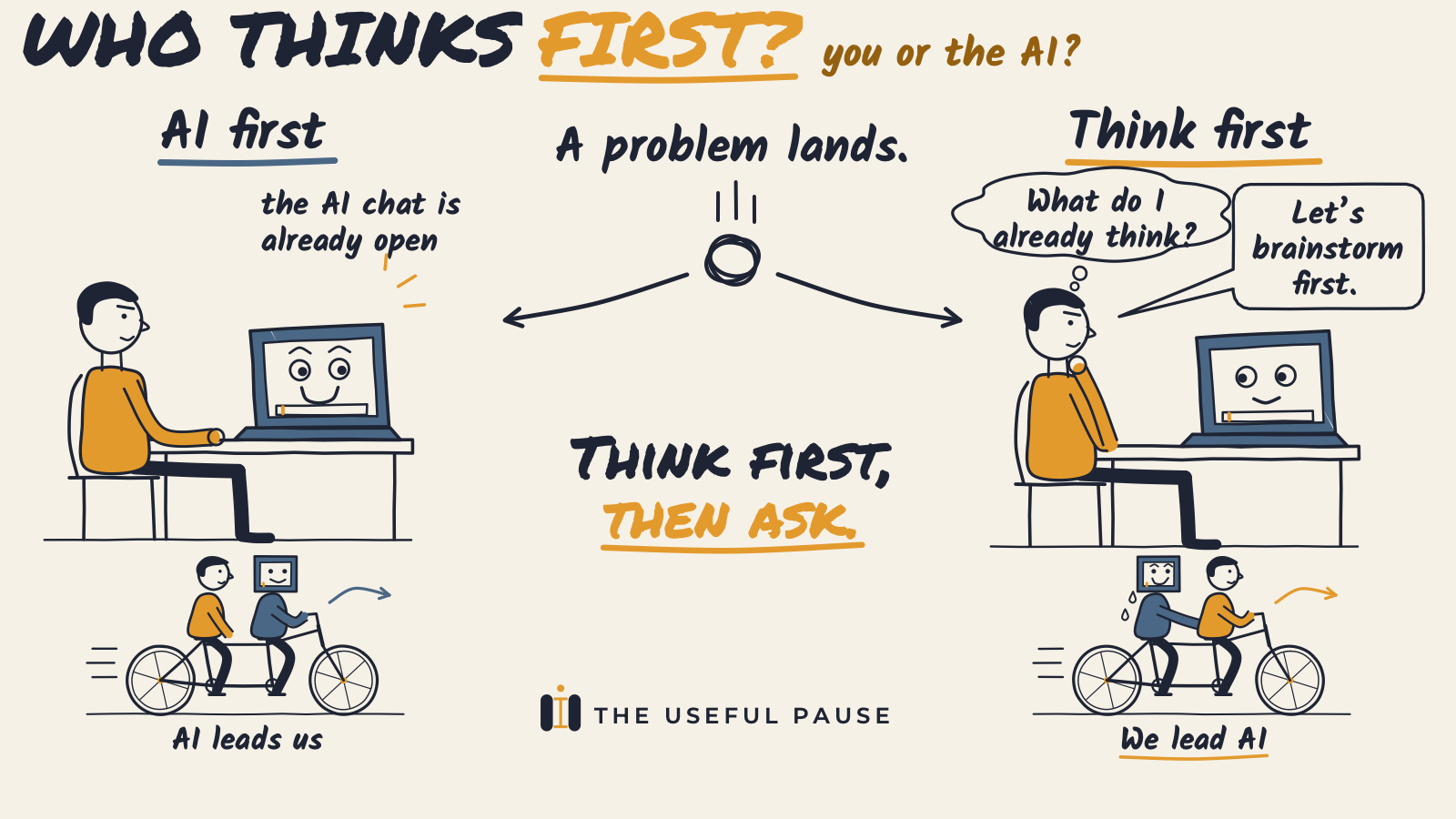
A problem lands on your desk, and before you have thought about it, the AI chat is already open. Many of us do it on impulse, again and again. Over time, that habit determines whether we lead AI, or AI leads us. A 2026 study suggests that opening AI first may shape our thinking in ways we don’t see.
Technology is here for everyone, and staying away from it means falling behind. However, every tool gives us room to grow and takes a few things back. Neil Postman called this a trade-off. I can speak about this from my own experience, which I’m sure many of you have also gone through. In my first job in India in 2003, I had no mobile phone, but most phone numbers which I wanted to remember just stayed with me. Now, with a smartphone, I don’t remember most phone numbers. Other skills took their place, and we grew a lot.
AI is a different kind of trade. My phone holds the numbers. AI can hold our thinking. That is where we need to be careful.
In my last post, You Are the Watcher, I wrote about watching our impulses and the small gap before we act. With AI, that gap is the moment before you type the question. Who should think first?
Mina Lee of the University of Chicago and colleagues asked 393 people to play a city council member. Each read seven documents about a company that had polluted the water, then argued for or against its deal. Some had AI from the start, others later or never. Some got 10 minutes, others 30.
The answer depended on time. When people were rushed, starting with AI helped. With 30 minutes, those who started on their own, with AI later or not at all, tended to write stronger arguments than the AI-first groups. The difference was small.
Few people copied directly from the AI. Still, most of their essays echoed its points. The authors suggest that opening with AI may steer the rest of the essay.
Essay scores rose and fell with time and timing, but people’s ratings of their own critical thinking hardly moved. We may not notice it happening.
In Plato’s Phaedrus, Socrates tells a story set in Egypt. The god Theuth offers King Thamus an invention, writing, to improve people’s memory. People who trust marks on a page, the king replies, will stop using their own memory. They will have “the show of wisdom without the reality.” Postman said he had a point, yet writing gave back far more. AI can too, if we keep thinking for ourselves.
The experiment was one task in one sitting, with small groups. This study does not prove everything, but it is a useful warning.
AI is not bad. It’s very powerful, and sometimes you should absolutely use it early. However, when you have time, and you should make time, your own thinking should come first. Our habits run for years. Day after day, starting from AI’s first answer can slowly wear down our curiosity and judgment.
Before I begin a new project with Claude, I create the whole architecture in my head. I think about where the input comes from and what the output looks like. My first message is usually “Let’s brainstorm first.” I am not technical and don’t understand code, but I understand the business and the logic. So I ask it to walk me through it step by step. Later, I let it run some tasks on its own, but I want every decision to come back to me. It’s a co-worker for me. I’m still the one leading, though.
Think first, then ask. Next time a problem lands, pause before you open the chat and ask, “What do I already think?”
We reach for the phone too, and often no buzz comes first. More on that next time.
Forwarded to you? Then ask our usual question. Was this useful? If it was, subscribe free, and the next one comes straight to you.
P.S. If you like what we do here and find it meaningful, would you invite one person to the discussion? Forward this post, or tap Share below.